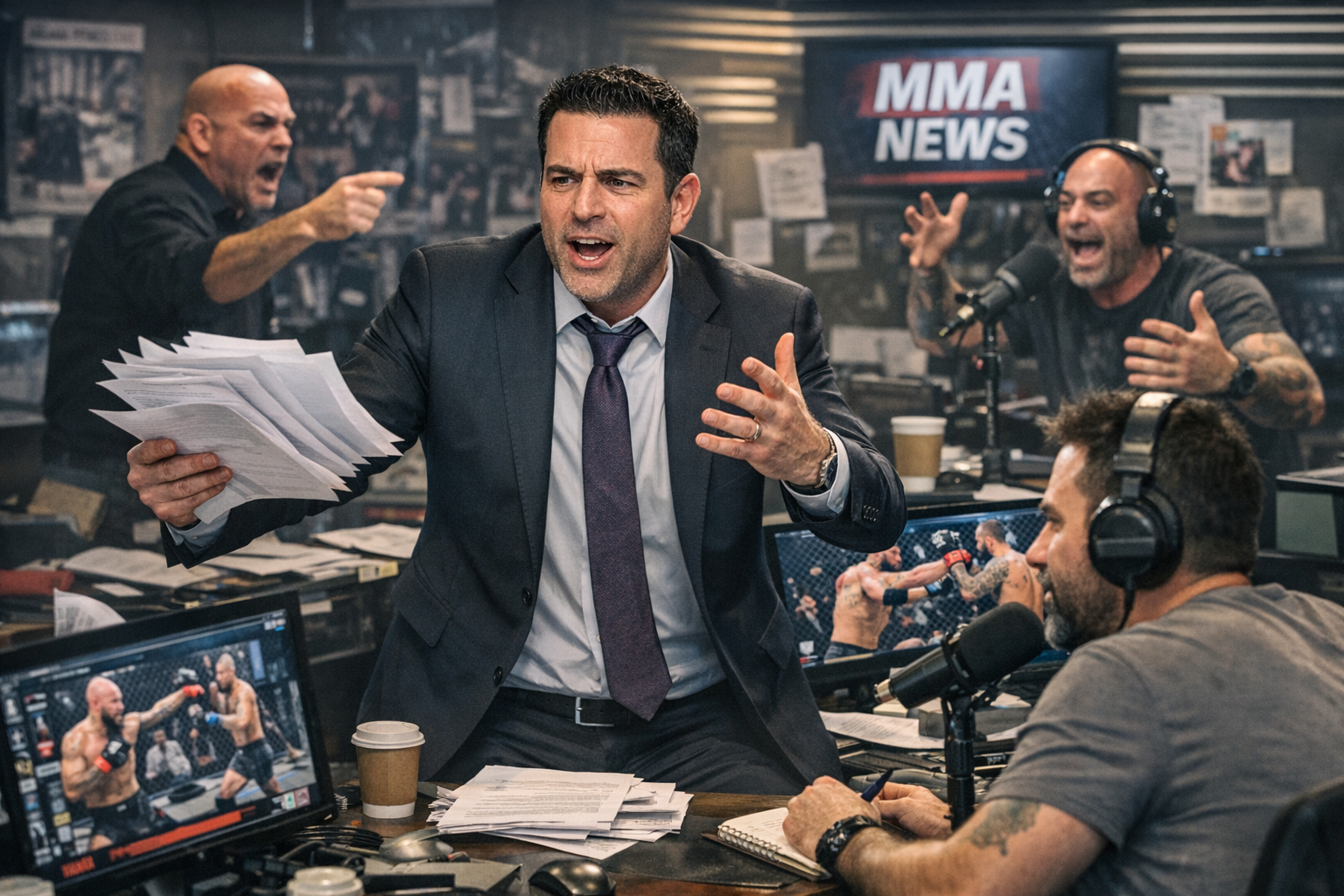
Monday belongs to fallout, and Ariel Helwhiney has plenty of it: Kevin Vallejos just bulldozed Josh Emmett at UFC Vegas 114, the bonus money is flowing, Harry Hardwick is talking tough after a brutal injury, and the wider MMA circus is already sprinting toward fresh chaos.
Table of Contents
Ariel Opens the Week
Vallejos Turns a Main Event Into a Statement
The Bonus Money and the Damage
Backstage Panic, Bo Nickal Noise, and the White House Card
Khamzat, Strickland, and the Rumor Machine
Final Word From the Monday Desk
1. Ariel Opens the Week
There are Mondays, and then there are Ariel Helwhiney Mondays.
The first kind involves coffee, inboxes, and mild disappointment. The second involves one hand on a microphone, the other hand on a fresh pile of grievances, and a face that says, I regret to inform you that the sport remains deeply unserious. This, naturally, is the second kind.
By Monday, March 16, the dust from UFC Vegas 114 had not so much settled as drifted into the lungs of everyone in the featherweight division. Kevin Vallejos had just torn through Josh Emmett in the main event, the UFC had handed out multiple $100,000 bonuses, and the usual post-event mixture of hype, pain, revisionism, and loud nonsense was already spilling into the new week.
Ariel Helwhiney entered the newsroom like a man arriving to testify before parliament.
“Let’s be very clear,” he said, adjusting his invisible moral superiority. “One weekend is enough to create three new contenders, five bad opinions, and at least one promotional overreaction. We are not here to celebrate chaos. We are here to document it.”
Dana Black, who had been pretending not to listen from the far side of the room, immediately shouted back, “You say that every week and then write four thousand words about a fighter raising one eyebrow.”
Ariel ignored him in the way only a veteran drama reporter can. He had a point. A card that looked, on paper, like a respectable Apex stopover had become something far more combustible by Sunday night.
And at the center of it all was Kevin Vallejos.
2. Vallejos Turns a Main Event Into a Statement
The headline matter is simple enough: Kevin Vallejos stopped Josh Emmett in the first round of the UFC Vegas 114 main event, scoring multiple knockdowns and forcing a TKO at 3:33 of Round 1. It was not a cautious arrival. It was a violent announcement.
That matters for two reasons.
First, Emmett was not some random warm body rolled into the cage to decorate a prospect’s highlight reel. He was a known name, a dangerous puncher, and exactly the sort of veteran test the UFC uses when it wants to learn whether a younger fighter is real or merely loud. Vallejos answered that question with the delicacy of a brick through a car window.
Second, Vallejos himself is already talking like someone who understands the size of the moment. In comments published Sunday, he said he wants to “leave my mark” on the featherweight division and made it clear he wants to earn his climb rather than be handed anything.
Daniel Cornmeat leaned back in his chair and nodded with the solemnity of a man about to compare elite combat to lunch.
“That kid looked like he came into the cage starving,” Daniel said. “Not hungry. Starving. There’s a difference. Hungry guys want a win. Starving guys bite through the plate.”
That, for once, was a useful contribution.
Because the featherweight division is one of those classes where momentum matters almost as much as ranking. A clean, emphatic finish over a veteran does more than move your number. It changes your atmosphere. Vallejos is not just another promising name this week. He is now the answer to one of Ariel’s favorite Monday questions: Who is everybody suddenly pretending they believed in all along?
Roe Jogan, naturally, took a more cinematic view.
“Bro, that wasn’t just a win,” Roe said, already vibrating at podcast frequency. “That was one of those moments where a division feels the door kick open. You can hear the top fifteen just locking their cars.”
Ariel rolled his eyes so hard they practically produced official scorecards.
Still, even he could not deny the obvious. Vallejos didn’t merely win. He altered the conversation.
3. The Bonus Money and the Damage
The UFC’s new $100,000 bonus era is helping create exactly the kind of Monday headlines promoters dream about and accountants dread. UFC Vegas 114 paid out two Performance of the Night bonuses and one Fight of the Night, with Kevin Vallejos and Manoel Sousa earning performance bonuses and Marwan Rahiki and Harry Hardwick taking Fight of the Night honors.
That last one came with a grim edge.
Rahiki vs. Hardwick was wild enough to earn the bonus, but the aftermath was rough: Hardwick was left dealing with a gruesome injury, later releasing a statement saying that no one needed to cry for him.
Ariel seized on that immediately.
“This,” he announced, pointing at the screen like a prosecutor with an exhibit, “is what this sport does every single week. It creates euphoria, damage, bravery, revisionism, and a dozen men saying they feel great while clearly held together by tape and adrenaline.”
Dana Black nodded approvingly because this sounded dramatic enough to be useful in a thumbnail.
There is also a deeper point here. The UFC wants memorable finishes and unforgettable fights. The doubled bonus structure encourages exactly that. On one level, great — fans get action, fighters get extra money, and cards gain identity. On another level, Monday is when the bill arrives. That bill is usually written in swollen faces, fractured jaws, and the very specific kind of stoicism fighters are expected to perform in public.
Daniel Cornmeat sighed. “One hundred grand is beautiful,” he said. “But getting your jaw broken for content is still a rough way to earn employee of the month.”
For perhaps the only time all morning, the room agreed with him.
4. Backstage Panic, Bo Nickal Noise, and the White House Card
Because MMA is unable to experience one story at a time, the Monday cycle is already pivoting toward the next shiny argument.
One of the loudest is the latest chapter in the Bo Nickal orbit. According to MMA Fighting, Colby Covington said he would fight Nickal only if Nickal dropped to welterweight, while Nickal remains booked to face Kyle Daukaus on the June 14 White House card. That alone is enough material to keep an outrage economy alive for several business days.
Ariel, whose soul is nourished by conflict with timestamps, was delighted.
“Observe,” he said. “A man demands a fight he is not taking on a card that already has another opponent attached, and somehow this becomes a debate about courage. This sport is a traveling misinformation carnival.”
Conor McBragger then wandered into the discussion uninvited, which is his most natural state.
“White House card?” he barked. “I should be headlining that on the lawn in a velvet suit. Give me a microphone, two rounds, and a marine band. You’ve never seen democracy like it.”
No one had asked.
Still, the White House event chatter matters because it shows how quickly this sport rotates from result to rumor to future spectacle. Vallejos can score a statement win on Saturday and by Monday the attention marketplace is already auctioning emotional energy to new storylines. That is not necessarily unfair. It is just the MMA calendar functioning as intended: relentless, unserious, and impossible to fully control.
5. Khamzat, Strickland, and the Rumor Machine
If Ariel Helwhiney had his own state religion, it would be called weaponized context.
So naturally he spent part of Monday obsessing over the newest Khamzat Chimaev story. Daniel Cormier said he has heard that Chimaev is pushing training partners so hard ahead of his May 9 middleweight title defense against Sean Strickland at UFC 328 that he’s effectively putting a “bounty on himself” to force elite-level resistance in camp. Cormier framed it as a bizarre inversion of “Bountygate,” and also noted the unresolved he-said/he-said around Chimaev and Strickland’s past gym sessions.
To Ariel, this is gourmet cuisine.
“This,” he said, “is premium Monday material. Anonymous gym whispers, a champion trying to become a myth, a former champion claiming prior knowledge, and Daniel Cormier comparing it all to a scandal reference. This is not a sport. This is serialized literature for men with bad sleep.”
Roe Jogan was thrilled.
“Bro, that’s what I’m saying. The great ones always do weird stuff. That’s how you know the energy is different. Normal people go for a run. Legends create mythologies in private rooms.”
Daniel Cornmeat, the only one trying to keep at least one shoe on the ground, cut in. “Or maybe guys in camp tell stories. That happens too.”
And there it is: the central Monday tension. MMA survives on the unstable marriage between verified outcome and emotionally satisfying rumor. Ariel thrives in that space. Dana monetizes it. Roe spiritualizes it. Daniel resists it for twenty seconds, then usually gives in.
As for Chimaev vs. Strickland itself, the real takeaway is that it is already being sold through intensity as much as skill. The training-room mythology is becoming part of the fight’s architecture weeks ahead of the event. Whether that mythology is accurate is one question. Whether it is effective is another. In MMA, the second one usually pays better.
6. Final Word From the Monday Desk
So where does that leave us?
Kevin Vallejos leaves the weekend as the biggest sporting winner after a fast, punishing stoppage of Josh Emmett. The UFC leaves with another card boosted by the new $100,000 bonus economy. Harry Hardwick leaves battered but defiant. The White House card leaves us arguing about fights that are not happening. And Khamzat Chimaev leaves the rumor mill spinning hard enough to power a medium-sized country.
Ariel Helwhiney closed the meeting with the tone of a man announcing institutional collapse.
“The sport remains unstable,” he said. “The people remain shameless. The headlines remain self-inflicted. In other words, we move.”
Dana Black stood up immediately. “Good. Tuesday, I want analysis, overreaction, three bad ideas, and at least one statement piece on whether Vallejos just scared the whole division.”
Daniel Cornmeat nodded. Roe Jogan looked ready to call it a civilizational turning point. Conor McBragger had already begun imagining himself in a White House co-main event he had not been offered.
And Ariel, against his better judgment, smiled.
Because however much he complains, Monday is his natural habitat: one part evidence, one part grievance, one part theater, and one fresh mess already forming over the horizon.
Tomorrow: Daniel Cornmeat takes the desk, and the question changes from what happened to what it actually means.