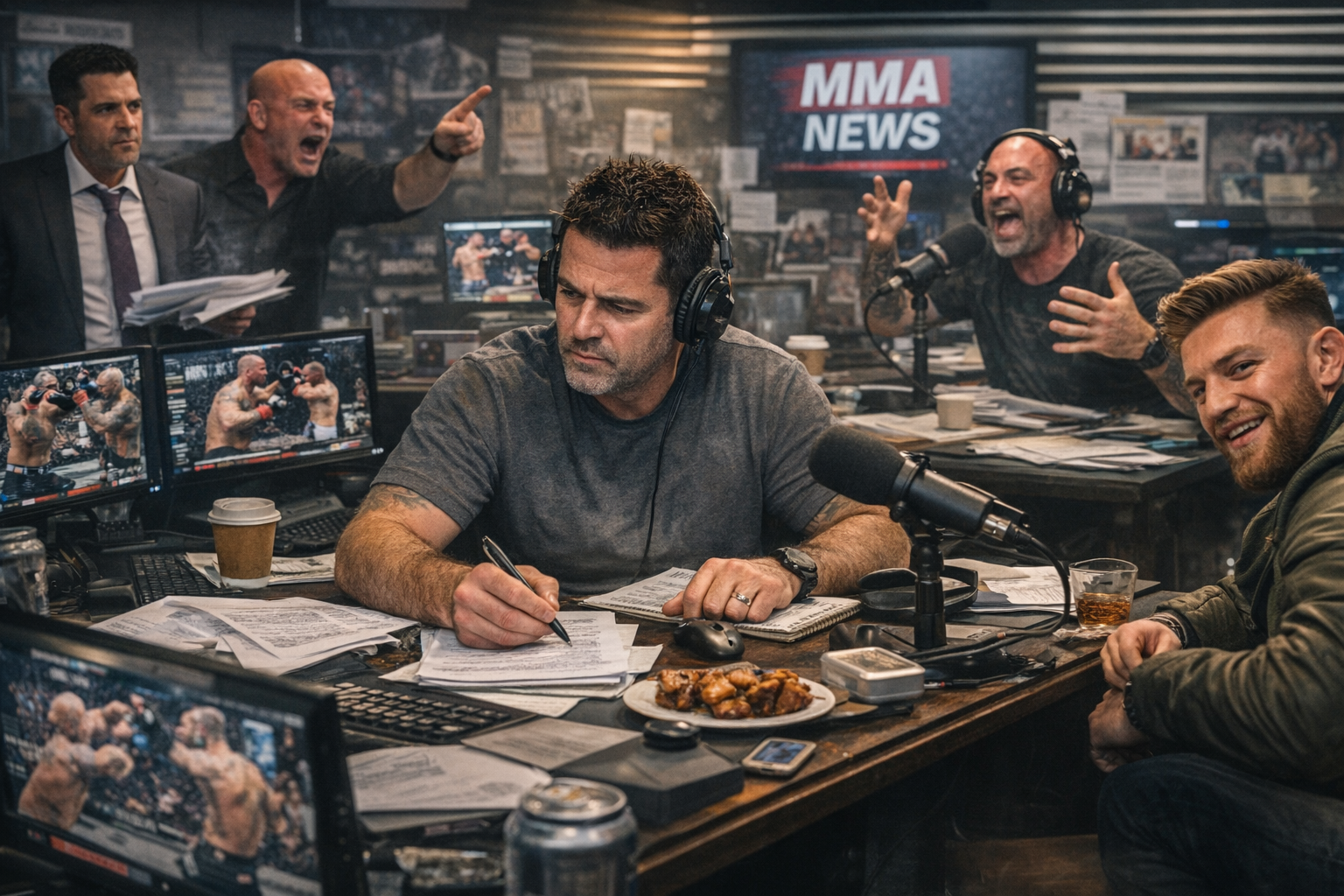
Tuesday is for analysis, which means Daniel Cornmeat has been handed the wheel at exactly the wrong time: Kevin Vallejos has smashed his way into the featherweight conversation, matchmakers are already fantasy-booking the aftermath, Nate Diaz vs. Mike Perry just landed on an absurdly loaded MMA card, and the sport is once again behaving like a man trying to grill chicken during a thunderstorm.
Table of Contents
Daniel Cornmeat Takes the Desk
What Kevin Vallejos Actually Changed
The Matchmaking Panic Begins
Nate Diaz, Mike Perry, and the Return of Pure Violence Economics
MVP, UFC, and the Busy Fight Calendar Problem
Final Word From the Tuesday Desk
1. Daniel Cornmeat Takes the Desk
There are two kinds of Tuesday in MMA.
The first is calm, reflective, analytical, and useful. The second is when Daniel Cornmeat is asked to provide calm, reflective, analytical, and useful thoughts while everyone around him behaves like escaped zoo animals.
This is the second kind.
By Tuesday morning, the sport was still digesting Kevin Vallejos flattening Josh Emmett in the UFC Vegas 114 main event, a result serious enough to change the featherweight mood and violent enough to make every “he’s not ready” take look like expired dairy left in the sun. MMA Fighting’s own matchmaking piece spent Monday trying to answer the obvious next question: what do you even do with Vallejos now?
Daniel Cornmeat sat at the desk with the expression of a man about to explain underhooks to people who think “momentum” is a personality trait.
“Everybody wants to sprint to the title picture after one big win,” Daniel said, tapping the monitor like he was checking a steak for doneness. “But there’s a difference between hot and cooked. Vallejos is hot right now. The question is whether the UFC lets him cook or throws him straight into a kitchen fire.”
Dana Black, naturally, hated the moderation.
“Cook?” Dana barked from somewhere behind a mountain of notes he had no intention of reading. “The kid iced Josh Emmett in one round. I want panic. I want contenders hiding in stairwells. I want at least three ranked featherweights pretending they’ve always respected him.”
Roe Jogan nodded like Dana had just explained quantum mechanics.
“Bro, yes. This is what happens when a division feels a predator show up.”
Daniel sighed the sigh of a man who knows the room is about to get dumber before it gets smarter.
2. What Kevin Vallejos Actually Changed
Let’s start with the simple part.
Vallejos did not just win. He violently stopped Emmett in Round 1, and that matters because Emmett was exactly the sort of veteran benchmark the UFC uses to test whether a rising fighter is a real threat or just a nice highlight package. Vallejos passed the test by setting the test on fire.
That kind of win changes three things at once.
First, it changes how fans talk about you. Before Saturday, Vallejos was a promising featherweight. After Saturday, he is the guy people mention with the slightly lowered voice that means, “Yeah, alright, maybe this one is a problem.”
Second, it changes how matchmakers think about risk. MMA Fighting’s post-event matchmaking discussion immediately started looking at meaningful next steps rather than soft protection, which tells you all you need to know about how quickly his stock moved.
Third, it changes how the division feels. Featherweight is one of those classes where established names can get comfortable circling the same cluster of familiar threats. Then a younger, sharper, meaner presence arrives and suddenly everybody starts talking about “timing” and “proper development” and “smart career moves.” Translation: nobody wants fresh problems unless the paycheck justifies the headache.
Daniel, to his credit, kept the analysis grounded.
“What I liked wasn’t just the finish,” he said. “It was the confidence. No wasted movement. No panic. No looking around like he was surprised to belong there. That’s the part people miss. Big punchers can scare you. Calm punchers can ruin your year.”
For once, that was both funny and correct.
Ariel Helwhiney, who had wandered back into the room despite Tuesday technically not belonging to him, immediately tried to turn this into a broader institutional crisis.
“So we agree, then,” Ariel said, with the oily satisfaction of a man arranging blame on a shelf, “that one knockout has now created an emergency for the ranking ecosystem, the booking calendar, and every featherweight who was enjoying a peaceful week.”
“No,” Daniel said. “We agree one fighter looked great.”
Ariel looked offended by the existence of restraint.
3. The Matchmaking Panic Begins
This is where MMA gets both fascinating and deeply annoying.
The moment a prospect scores a breakout win, the sport develops amnesia. Everybody forgets they were skeptical 72 hours earlier and begins acting like they always knew greatness was inevitable. Then comes the fantasy booking — and with it, the panic.
MMA Fighting’s “On To the Next One” piece framed exactly that conversation, discussing possible future opponents for Vallejos as his profile rises off the back of the Emmett finish. That alone tells you he has crossed from prospect chatter into serious matchmaking territory.
Dana Black immediately took this as permission to behave irresponsibly.
“Give him somebody ranked,” Dana declared. “No, give him two ranked guys. Book them both. One in June, one in August. Let’s find out if this division has any grown men left in it.”
Daniel rubbed his temples.
“This is why you’re not allowed near portion sizes or prospect development,” he muttered.
The real answer is somewhere between Dana’s caffeine-fueled recklessness and Ariel’s preferred six-week opera about what the win “symbolizes.” Vallejos should get the kind of fight that confirms whether the Emmett performance was the start of a climb or the peak of a perfect night. Not a sacrifice. Not a gimmick. Not a random unranked body. A meaningful step.
Roe Jogan, however, was already somewhere else spiritually.
“Bro, this is how legends begin. One veteran. One statement. Then suddenly everybody’s watching tape at midnight.”
“That,” Daniel said, “is not analysis. That is a trailer voice.”
But even he knew Roe had accidentally wandered near the truth. Vallejos now matters because he has become an answer to the division’s favorite question: who is the next dangerous man no one wants to say yes to too quickly?
4. Nate Diaz, Mike Perry, and the Return of Pure Violence Economics
As if the UFC matchmaking machine wasn’t noisy enough, Tuesday also brought one of the most gloriously deranged booking announcements in recent memory: Nate Diaz vs. Mike Perry is now part of the May 16 MVP card at the Intuit Dome, joining a lineup that already includes Ronda Rousey vs. Gina Carano and Francis Ngannou vs. Felipe Lins. MMA Fighting described it as a blockbuster addition, which, frankly, undersells the level of combat-sports chaos involved.
Daniel leaned back and gave the sort of laugh that means he both respects and distrusts what he is seeing.
“That fight makes perfect sense if your business model is built around asking one question,” he said. “How much sanctioned violence can we fit on one poster before the internet melts?”
He is right.
Nate Diaz vs. Mike Perry is not just a fight. It is an event made out of vibes people are willing to pay for. Diaz has not fought MMA since his 2022 submission win over Tony Ferguson, and Perry’s recent identity has been tied more to BKFC than traditional MMA, where he has built a six-fight unbeaten run and the “King of Violence” persona. That is exactly why the matchup works: it sells confrontation, not merely divisional relevance.
Conor McBragger, now fully awake because spectacle had entered the chat, offered his usual helpful contribution.
“Now that,” he said, strolling in like he had been invited by a brass band, “is a fight poster. That’s testosterone and bad intentions. That’s what the people want. Not these spreadsheets Ariel kisses at night.”
Ariel, from somewhere off camera, immediately shouted that he had never kissed a spreadsheet in his life, which is exactly the kind of denial that raises new questions.
The larger point here is that combat sports in 2026 increasingly run on parallel tracks. On one side, you have ranking logic, divisional progress, and technical merit. On the other, you have giant spectacle fights that operate almost like pop-up festivals for violence. Diaz vs. Perry belongs firmly in the second lane, and it is probably going to do huge attention numbers because the audience understands exactly what sort of mayhem they are buying.
5. MVP, UFC, and the Busy Fight Calendar Problem
This is where Tuesday’s story gets bigger than one knockout or one bizarre super-card.
The MMA calendar is getting crowded with events that demand totally different kinds of attention. The UFC is trying to build around emerging contenders like Vallejos while also juggling side narratives like the White House card chatter and the ongoing noise around fighters like Bo Nickal. At the same time, rival-promotional events are building attraction through pure star power and crossover violence.
That creates a strange problem for fans and fighters alike: what exactly counts as the center of the sport now?
Daniel’s answer, refreshingly, was practical.
“The real center is still the divisions,” he said. “You can sell all the weird giant cards you want, and some of them are gonna be fun as hell. But if a prospect knocks out a veteran in the UFC and changes a real weight class, that still matters more to the actual sport.”
That is the ex-fighter in him talking, and he is right.
But the commercial reality is messier. A blockbuster one-off like Diaz vs. Perry can dominate conversation even if it changes nothing structurally. A divisional breakthrough like Vallejos over Emmett can matter a lot competitively while still fighting for headlines against bigger celebrity-driven chaos. The result is a sport that feels simultaneously overbooked and underorganized.
Roe Jogan, thrilled by this, called it “proof we are living in peak combat culture.”
Daniel called it “proof no one can focus for more than six minutes.”
Both may be correct.
6. Final Word From the Tuesday Desk
So what does Tuesday actually leave us with?
Kevin Vallejos is no longer just an intriguing prospect. After his emphatic finish of Josh Emmett and the immediate matchmaking discussion that followed, he is now an active variable in the featherweight division. That is real.
At the same time, Nate Diaz vs. Mike Perry is exactly the kind of high-voltage nonsense-fest that reminds you the sport is not governed by rankings alone. It is governed by appetite. Sometimes for excellence. Sometimes for spectacle. Sometimes for both at once.
Daniel Cornmeat closed the desk with the air of a man summarizing a feast he didn’t entirely trust.
“Here’s the simple version,” he said. “Vallejos might be the next serious featherweight problem. Diaz and Perry is absolutely insane. And if you can’t tell the difference between a divisional shift and a carnival attraction, this sport will rob your attention every week.”
Dana Black stood up immediately.
“Good. Wednesday belongs to Tito. I want broken wisdom, accidental poetry, and at least one sentence so confusing it becomes profound by force.”
From the hallway, Tito Wordsmith could already be heard warming up.
“At the middle of tomorrow, the future is before behind us,” he announced to nobody in particular.
Daniel closed his eyes. Roe applauded. Ariel started taking notes against his will.
And somewhere in the distance, the sport kept moving — fast, loud, and with absolutely no respect for portion control.