Introduction
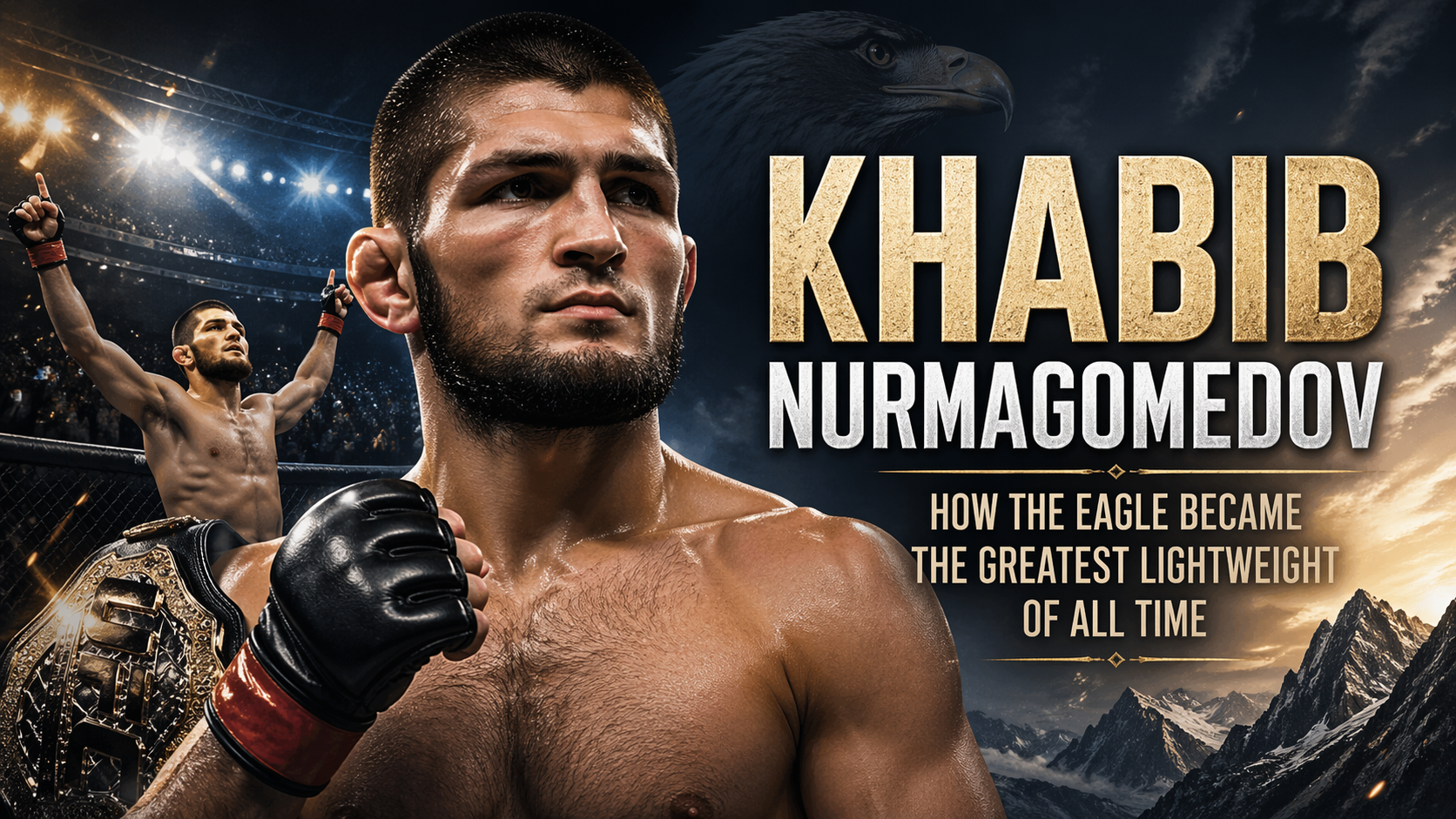
There are fighters who dominate their era, and then there is Khabib Nurmagomedov. The Eagle retired with a perfect 29-0 record, went 13-0 in the UFC, and never once came close to losing. Not a single round that felt genuinely dangerous for him. Not a single opponent who ever looked like they had an answer. He did not just win fights — he suffocated people. He broke them physically, and then he broke them mentally, and there was almost nothing anyone could do about it. If you want to understand why the lightweight division looks the way it does today, and why Dagestani grapplers are all over every major promotion on earth, the answer starts and ends with Khabib. This is the full story of how he did it.
Contents
Where He Came From: The World That Built Khabib
- The Blood of Imam Shamil
The Father: Abdulmanap and the System Behind the Legend
- The Bear, the Mountains, and the Method
The Early Career: Building the Machine
The UFC Years: A Grappling Puzzle Nobody Could Solve
- The Dagestani Handcuff: Breaking Down His Ground Control
- Why His Striking Was Better Than People Think
The Championship Reign: Four Title Fights, Four Masterclasses
- The McGregor Fight
- The Gaethje Fight and the Retirement
The Legacy: How Khabib Changed MMA Forever
Career Timeline: The Key Moments in Chronological Order
FAQs
Where He Came From: The World That Built Khabib
Khabib Nurmagomedov was born on September 20, 1988, in a tiny mountain village called Sildi in the Republic of Dagestan — a rugged, geographically isolated region in the North Caucasus with a population of around three million people. On paper, nothing about this place should be producing world champions at the rate it does. But Dagestan has been pumping out elite wrestlers, judokas, and combat sambo competitors for generations, and it is not a coincidence. It is culture. It is environment. And in Khabib's case, it is something that goes even deeper than sport.
The Avar people of Dagestan — Khabib's ethnic group — have been fighters for centuries, not by choice but by necessity. The terrain of the Caucasus Mountains is as unforgiving as any landscape on earth, and the people who carved a life out of it had to be physically and mentally tougher than their circumstances. That tradition of toughness did not disappear when MMA came along. It simply found a new arena.
The Blood of Imam Shamil
When Khabib talks about his inspiration, one name comes up more than any fighter or athlete: Imam Shamil. In the 19th century, Shamil — an Avar leader and a Sufi scholar — spent twenty-five years fighting a guerrilla war against the imperial Russian army in the Caucasus Mountains. The Tsar's forces eventually had to literally deforest entire regions just to deny Shamil's warriors their cover. He was ultimately captured but never truly beaten, and his story of resistance against overwhelming odds became central to the Avar cultural identity. Khabib's great-grandfather served as an officer in Shamil's army. This is not ancient history to Khabib. It is his bloodline.
This is important context for understanding why Khabib never cracked. Fighters get knocked down by pressure — not just physical pressure, but the weight of expectation, the chaos of fight week, the fear of losing, the ego-driven fluctuations that derail so many careers. Khabib seemed genuinely immune to all of it. His faith, his family history, his cultural framework — they gave him an internal stability that was almost impossible to disturb. His lifestyle reflected it too: training, religion, sleep, food. That was it. No distractions, no excesses, no ego. He was the second most popular Muslim athlete in the world behind Mohamed Salah, and he carried that platform with a quiet, unshakeable dignity.
The Father: Abdulmanap and the System Behind the Legend
You cannot tell the Khabib story without telling the Abdulmanap story. His father was a Soviet military veteran, a master of sports in freestyle wrestling, a Ukrainian National Sambo champion, and a judo black belt. He was also, by all accounts, a visionary coach who understood something most trainers do not: that producing a world champion is a long-term engineering project, not a lucky accident. He took his son's development with the seriousness of an architect and the dedication of a patriarch.
Abdulmanap blended Soviet sports science — which is arguably the most rigorous and systematic approach to athletic development ever created — with the spartan conditions of the Caucasus Mountains. He did not believe in shortcuts. He believed in volume, repetition, and extreme environmental conditioning. Every summer, his fighters left the city behind and spent months in the high-altitude mountains — sprinting hills, swimming in freezing rivers, drilling grappling on bare mats in thin air. Training at altitude forces the body to produce more red blood cells to compensate for the lack of oxygen, which means that when you come back down to sea level, you have a cardiovascular engine that most fighters simply cannot match. In MMA, where exhaustion is the most dangerous opponent of all, that biological advantage was decisive.
The Bear, the Mountains, and the Method
When Khabib was nine years old, just days after his birthday, his father put him on a mat with a bear cub. Yes, an actual bear. The footage still exists. Western media tends to treat this as a viral oddity, but it was actually a deliberate teaching moment. A nine-year-old boy wrestling an animal with far superior raw strength learns something immediately: technique and will can overcome physical disadvantage. The young Khabib tucked his chin, drove in, and grappled with the thing. That instinct — attack what is bigger and stronger than you, use your technique, never quit — was the entire Manapov philosophy in one three-minute clip. He was not raised to fear strong opponents. He was raised to study them.
The Early Career: Building the Machine
Before anyone in the West had heard of Khabib Nurmagomedov, he was going 16-0 in regional Russian and Ukrainian promotions — M-1 Global, ProFC, the Pankration Atrium Cup — fighting constantly, sometimes three or four times in a single year. Critics sometimes point to the level of opposition in this period. Some of his early opponents were making their professional debuts and never fought again. The combined records of his first sixteen opponents were 57 wins and 46 losses. On the surface, it looks like easy pickings.
But that misses the point of what Abdulmanap was actually doing. Combat sports are learned in live rounds — not on pads, not in the gym, but in real fights with real stakes. The brain and body under extreme adrenaline respond differently than they do in training, and the only way to adapt to that is to experience it repeatedly. By the time Khabib stepped into the UFC in 2012, he had been through sixteen professional fights in just over three years. His nervous system had been through the cage fight experience enough times that it was no longer a crisis to manage. It was just another day at the office. That level of composure cannot be faked or taught in a short time. Abdulmanap built it deliberately, systematically, over years.
The UFC Years: A Grappling Puzzle Nobody Could Solve
The best way to understand Khabib's UFC record is to look at what he did statistically. He fought 38 complete rounds across 13 bouts. He lost two of them — one against McGregor, one against Gaethje — both debatable. Seven of those rounds were scored 10-8 by the judges, meaning he so thoroughly dominated his opponents that the standard 10-9 scoring could not adequately capture the gap. He was not just winning rounds. He was winning them so completely that the judges ran out of numbers. In an era of extreme competitive parity at the top of the UFC, that is almost incomprehensible.
His approach to the octagon was tactically sophisticated in a way that is easy to miss if you are only watching the highlights. His striking — which many casual observers dismissed as basic — was not designed to knock people out. It was designed to move them backward in a straight line until the cage fence stopped them. Once an opponent's hips hit the fence, their entire defensive toolkit evaporated. You cannot sprawl if you have a steel cage wall directly behind you. You cannot retreat. You cannot create the angle you need to defend a takedown. Khabib turned the most neutral piece of equipment in the sport — the cage itself — into his greatest weapon.
The Abel Trujillo fight in 2013 is still one of the most telling performances of his career. He set a UFC record with 21 takedowns in three rounds. But more instructive than the number is the method: every time Trujillo defended and got back to his feet, Khabib did not disengage and reset. He stayed attached, maintained his body lock, and chained another takedown sequence immediately. There was no pause. No gap. No chance to breathe or recover. The chain never broke.
The Dagestani Handcuff: Breaking Down His Ground Control
Once the fight hit the mat, Khabib did something that subverted every instinct trained into traditional BJJ practitioners. Instead of trying to pass guard — which creates space, and space is all a high-level grappler needs to scramble back to their feet — he went hunting for the wrist. This is the technique that MMA coaches and analysts now call the Dagestani Handcuff, and it is as simple in concept as it is impossible to escape in execution.
Here is how it works: from top position, Khabib reaches under or around the opponent's body to grab their far wrist. He pins that arm behind their own back or traps it against their torso. Then he drives his head under their chin, brings his hips forward, and puts his entire body weight into them. The result is that the opponent is lying on their own trapped arm. They cannot post. They cannot bridge. They cannot generate the upward force needed to stand up. And because their face, ribs, and head are completely exposed, they are absorbing elbows and punches while physically unable to block them. World-class Brazilian jiu-jitsu practitioners — men who had spent their entire careers learning to escape from bad positions — were utterly helpless once this grip was established. Their levers were gone. Their options were gone. All they could do was survive and wait for the round to end.
From there, his leg riding system locked the lower body. He would step his leg over the opponent's near leg and triangle his own legs together behind it — not unlike a heel hook entry position — which anchored his lower body completely while freeing his hands to throw punches. This is what he did to Conor McGregor against the fence in Round 4 before finishing with the neck crank. And when opponents tried to explode their legs to escape, it fed directly into his submission game. Strikes forced the arms up. Arms up exposed the chest. Chest exposed meant the armbar was on. Armbar defence meant rolling inward. Rolling inward was the mounted triangle. The entire chain had one direction of travel: toward the finish.
Why His Striking Was Better Than People Think
The persistent narrative that Khabib had poor or limited striking is simply wrong, and the numbers prove it. He maintained a 65% significant strike defence rate throughout his career and absorbed just 1.75 significant strikes per minute — elite numbers by any measure. Dustin Poirier is a genuinely dangerous boxer who has finished numerous top-tier lightweights. Edson Barboza was considered one of the most devastating strikers in UFC history. Neither of them were able to land clean or establish rhythm against Khabib. And the reason is not that Khabib was slipping punches and rolling shoulders. The reason is that the constant threat of the takedown made it impossible for them to plant their feet and generate power. They threw arm punches with bent knees and a wide stance, because anything else left their legs exposed. The takedown threat was the best striking defence in the game. It was psychological pressure converted into physical limitation.
The Championship Reign: Four Title Fights, Four Masterclasses
Khabib won the undisputed UFC Lightweight Championship in April 2018, stopping Al Iaquinta via unanimous decision in a fight Iaquinta only took on six days' notice. He then made three defences before retiring. Each one was a clinic against a completely different stylistic threat, and each one was won convincingly.
The McGregor Fight
UFC 229, October 2018. The biggest MMA event in history at the time, drawing over 2.4 million Pay-Per-View buys. The build-up was laced with genuine bad blood after McGregor and his entourage attacked a bus carrying Khabib and his teammates during fight week, injuring two fighters. The emotion was real and the narrative was massive. And then the cage door closed, and Khabib just went to work. He dropped McGregor with an overhand right in Round 2. He dragged him down repeatedly, pinned him against the cage, and controlled every second of the fight. By Round 4, McGregor was exhausted and taking sustained punishment. The neck crank came, McGregor tapped, and Khabib scaled the cage fence in celebration before things descended into the post-fight brawl that defined the night's chaos. The fight itself, though, was one-sided from the first exchange.
Against Dustin Poirier at UFC 242 in Abu Dhabi, Khabib survived one of the most dangerous moments of his career — a deep, fully locked guillotine choke in the first round — by maintaining his technical composure under enormous pressure, slowly relieving the squeeze, reversing the position, and finishing with a rear-naked choke in Round 3. It was a fight that showed he could problem-solve in real time, not just execute a pre-planned game plan.
The Gaethje Fight and the Retirement
Justin Gaethje at UFC 254 was the last fight Khabib ever had, and it might be the most technically perfect of his career. Gaethje is a Division I wrestler who had spent years developing anti-wrestling defence specifically to neutralise grappling-heavy fighters. He also has some of the most punishing leg kicks in the sport. Khabib walked through them. He absorbed the shots, kept marching forward, got the takedown, climbed into mount, started throwing ground and pound that forced Gaethje to raise his arms, slid into the S-mount threatening the armbar, and when Gaethje rolled to defend it, he was already inside the mounted triangle. Gaethje was unconscious before the referee even got there. The whole sequence — from takedown to finish — played out exactly like the coaching staff had drawn it up. Round 2, perfect execution, done.
Then he sat on the mat, pressed his face to the canvas, and wept. His father had died four months earlier from complications related to COVID-19, just days after coming out of an induced coma following a heart procedure. He had promised his mother he would not fight without Abdulmanap by his side. Sitting in the Abu Dhabi heat with his team around him, Khabib announced his retirement. He was 32 years old. He was the best lightweight who had ever lived. And he walked away.
The Legacy: How Khabib Changed MMA Forever
Khabib's retirement did not end the system. It just put it in different hands — his own. He stepped into the coaching role that Abdulmanap had filled, took over Eagles MMA, and began guiding the next generation. The results have been immediate and overwhelming. Islam Makhachev won the UFC Lightweight Championship and defended it multiple times using the exact same framework — high-altitude conditioning, pressure grappling, psychological dominance. Usman Nurmagomedov became the Bellator Lightweight Champion. Umar Nurmagomedov, Khabib's cousin, is one of the most feared prospects in the bantamweight division. The Manapov school is not a single fighter's legacy. It is a system that keeps producing world champions because the methodology is sound and the culture that created it has not changed.
The tactical influence is even broader than the fighters he directly trains. The entire sport shifted after Khabib. Every lightweight contender now has to have a serious answer for elite wrestling and cage control, because if they do not, Dagestani grapplers will expose them. The way top teams approach grappling defence, anti-wrestling drilling, and cage work all changed in the years after Khabib dominated the division. He did not just beat everyone in front of him. He rewrote the game plan the whole sport had to follow.
Javier Mendez — his head coach at AKA and one of the most respected minds in the sport — said that even during his active career, Khabib would finish a gruelling five-round sparring session and immediately sit down with the coaches to help his training partners work through their rounds. He was building the next wave while still competing in the current one. Mendez believes Khabib is on track to become the greatest MMA coach in history. Given the evidence, it is hard to argue.
The bottom line on Khabib Nurmagomedov: 29-0, never hurt badly, never wobbled, never broken. A cultural foundation forged in Dagestani mountain villages. A father who was obsessed with perfection. A training system built on suffering, repetition, and altitude. And a grappling framework so complete, so suffocating, and so technically sound that the world's best fighters spent entire camps trying to crack it and failed every single time. He was not a fighter who got lucky. He was the inevitable product of everything that went into making him. The Eagle remains undefeated. The legacy remains unmatched.
Career Timeline: The Key Moments in Chronological Order
September 20, 1988 — Born in Sildi, Dagestan
Khabib Nurmagomedov is born in the remote mountain village of Sildi in the Republic of Dagestan, Russia, to Abdulmanap and Siyavush Nurmagomedov. He is of Avar descent, an ethnic group with a centuries-long tradition of martial resistance and physical toughness. His great-grandfather served as an officer in Imam Shamil's 19th century resistance army against Tsarist Russia.
September 1997 — Wrestles a Bear Cub Aged Nine
Abdulmanap places Khabib on a mat with a bear cub just days after his ninth birthday, captured on handheld video. The exercise is a deliberate lesson in the Manapov system: technique and willpower can neutralise superior physical strength. The young Khabib tucks his chin and engages without hesitation. He has already been training freestyle wrestling since the age of eight.
2008–2011 — Goes 16-0 in Regional Promotions
Khabib makes his professional MMA debut in 2008 and proceeds to go 16-0 in Russian and Ukrainian promotions including M-1 Global, ProFC, and the Pankration Atrium Cup. Abdulmanap keeps him fighting at high volume — sometimes three or four times per year — to build the cage composure and neurological adaptation that cannot be replicated in a training gym. By the end of this run, Khabib is ready for the world stage.
January 2012 — UFC Debut
Khabib makes his UFC debut at UFC 142, submitting Kamal Shalorus with a rear-naked choke in Round 3. He relocates to San Jose, California, to train at the American Kickboxing Academy (AKA) under Javier Mendez, adding world-class striking defence and cage awareness to his Dagestani grappling base. The combination proves lethal.
June 2013 — Sets UFC Record: 21 Takedowns vs Abel Trujillo
At UFC 160, Khabib records 21 takedowns against Abel Trujillo across three rounds — a UFC record that still stands. The performance is not just a statistical highlight but a demonstration of his chain wrestling philosophy: no defensive reaction by the opponent is accepted as a failure. Every scramble feeds directly into the next sequence. There are no gaps.
July 2014 — The Tibau Fight Forces a Tactical Evolution
The Gleison Tibau fight at UFC 148 is the closest Khabib comes to a genuine tactical problem. Tibau — a physically massive veteran with a historically elite takedown defence — stuffs all 13 of Khabib's takedown attempts. Khabib wins a narrow unanimous decision on pressure and volume, but the experience is a catalyst. From this point forward, he significantly de-emphasises mid-cage double-legs and shifts almost entirely to cage-based grappling using the fence as a structural tool.
April 2018 — Wins the UFC Lightweight Championship
At UFC 223, Khabib defeats Al Iaquinta via unanimous decision over five rounds to win the undisputed UFC Lightweight Championship. Iaquinta had taken the fight on six days' notice as a late replacement, but provided genuine resistance over the full distance. Khabib is now 26-0. He is the champion. The division belongs to him.
October 2018 — Submits Conor McGregor at UFC 229
UFC 229 becomes the best-selling UFC event of all time, drawing over 2.4 million pay-per-view buys. The fight itself is clinical. Khabib drops McGregor in Round 2, controls the fight entirely, and finishes with a neck crank submission in Round 4. The post-fight brawl — triggered by McGregor's teammate attacking Khabib's corner — overshadows the performance itself, but does nothing to alter the result. Khabib is fined and suspended. McGregor never fights for a UFC title again.
September 2019 — Submits Dustin Poirier at UFC 242
Fighting in Abu Dhabi at UFC 242, Khabib survives a deep guillotine choke attempt from Poirier in Round 1 before methodically breaking him down and finishing with a rear-naked choke in Round 3. The guillotine moment is the most danger Khabib faces in his entire UFC career. His composure in escaping it — slowly, technically, without panic — is one of the most impressive sequences in his championship run.
July 2020 — Abdulmanap Nurmagomedov Passes Away
Abdulmanap Nurmagomedov dies in a Moscow military hospital from complications following COVID-19 and a prior heart condition. He was 57 years old. The loss is devastating for Khabib, who describes his father as his closest friend, the architect of everything he has achieved, and the only person whose presence made fighting feel meaningful. He has one fight left to honour.
October 2020 — Submits Gaethje, Retires 29-0 at UFC 254
At UFC 254 on Yas Island, Abu Dhabi, Khabib submits Justin Gaethje via mounted triangle choke in Round 2 in what many consider the most technically perfect performance of his career. He then removes his headgear, sits on the canvas, and weeps. Seconds later, he announces his retirement, citing the promise made to his mother. He is 32 years old. Final record: 29-0. He is the greatest lightweight in UFC history.
2021 Onwards — Building the Next Generation
Khabib takes over as head coach and patriarch of Eagles MMA and continues working with Javier Mendez at AKA. He guides Islam Makhachev to the UFC Lightweight Championship and multiple successful defences. Usman Nurmagomedov wins the Bellator Lightweight title. Umar Nurmagomedov emerges as one of the most dangerous bantamweight prospects in the sport. The Manapov school continues to produce world champions. The Dagestani wave shows no sign of stopping.
FAQs
What is Khabib Nurmagomedov's professional record?
Khabib retired with a perfect professional record of 29-0, including 13-0 inside the UFC. He never lost a professional fight in his career, and he remains the only UFC Lightweight Champion to retire undefeated.
Why did Khabib Nurmagomedov retire?
Khabib retired immediately after submitting Justin Gaethje at UFC 254 in October 2020. His father, Abdulmanap, had died four months earlier from complications related to COVID-19 following a heart procedure. Khabib had promised his mother he would not fight without his father present. He was 32 years old and at the peak of his ability when he walked away.
What is the Dagestani Handcuff?
The Dagestani Handcuff is a top-control technique associated with Khabib's ground game. From a dominant top position, the fighter captures the opponent's far wrist and pins the arm behind or beneath their body, removing their ability to post, bridge, or generate any upward force to stand up. With the opponent trapped on their own arm and unable to defend, their face and head are exposed to sustained strikes. The technique became one of the most studied and copied positional methods in MMA following Khabib's dominance in the UFC.
Who has Khabib trained since retiring?
Since retiring, Khabib has guided Islam Makhachev to the UFC Lightweight Championship, cornered Usman Nurmagomedov to the Bellator Lightweight title, and developed Umar Nurmagomedov into one of the most dangerous prospects in the bantamweight division. He operates Eagles MMA and works alongside Javier Mendez at the American Kickboxing Academy. Mendez has publicly stated he believes Khabib is on track to become the greatest MMA coach in history.