Introduction
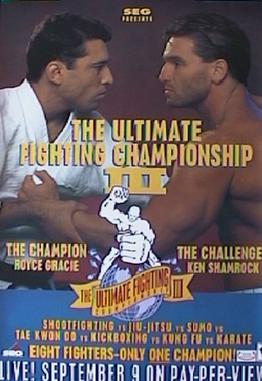
UFC 3: The American Dream arrived on September 9, 1994 as the sport's most chaotic and consequential night to date. For the first time in its brief history, the tournament ended without Royce Gracie standing victorious. Instead, the Grady Cole Center in Charlotte, North Carolina witnessed a card defined by injury, exhaustion, and a replacement fighter nobody expected to compete — let alone walk out as champion.
The card had been built around a presumed Gracie vs. Shamrock final — Jiu-Jitsu against the grappling powerhouse who came closest to stopping Gracie at UFC 1. But an obscure Hawaiian fighter named Kimo Leopoldo had other ideas. His quarter-final with Gracie became an instant classic — a brutal 4:40 war that left the champion physically unable to continue. When Gracie's corner threw in the towel before his semi-final had even started, the UFC's invincibility myth shattered in real time.
What followed was pure chaos. Shamrock won his semi-final but withdrew with a knee injury before the final, allowing alternate Steve Jennum — a Nebraska police officer and Ninjutsu black belt who had not competed all evening — to claim the championship in a single fight. It was unprecedented. It was controversial. And it changed the UFC's rulebook forever.
Contents
Quick Stats
The Build-Up
Tournament Final: Steve Jennum vs. Harold Howard
Headline Bout: Royce Gracie vs. Kimo Leopoldo
Full Results
Standout Performances
Records & Milestones
Legacy & Impact
FAQ
Quick Stats
📅 Date: September 9, 1994
📍 Venue: Grady Cole Center, Charlotte, North Carolina, USA
👥 Attendance: 3,000
📺 Broadcast: Pay-Per-View (SEG)
🏆 Tournament Winner: Steve Jennum (Alternate)
💰 Prize: $60,000
⚔️ Format: 8-Man Single-Night Tournament (no rounds, no time limits, no weight classes)
📊 PPV Buyrate: ~90,000
The Build-Up
After two dominant Royce Gracie performances, the UFC had built its identity around a single narrative: Gracie Family Jiu-Jitsu was the most effective fighting system in the world, and no combination of striker, grappler, or size advantage could overcome it. UFC 3 was intended to cement that story. Instead, it dismantled it.
The tournament returned to an eight-man format after the sixteen-man experiment at UFC 2, and featured the most physically imposing field assembled to that point. Most notable was Emmanuel Yarborough — a 6'8", 616 lb sumo champion — and Kimo Leopoldo, a Hawaiian fighter promoted by his manager Joe Son as a spiritual warrior who combined grappling, striking, and sheer physical menace. Kimo's theatrical presence created an atmosphere of genuine danger from the moment he was announced.
Ken Shamrock returned as the clear second favourite — the man the UFC hoped would create the climactic final the sport had been waiting for. Having lost to Gracie by heel hook at UFC 1, Shamrock had spent the intervening months refining his wrestling and cage work at his Lion's Den gym in Lodi, California. The anticipated Gracie vs. Shamrock final was the narrative the event was built around. What actually happened wrote a different kind of history.
Tournament Final: Steve Jennum vs. Harold Howard
Steve Jennum was never supposed to compete. The Nebraska police officer and Ninjutsu black belt arrived at UFC 3 as an alternate — on standby in case any competitor withdrew. When Ken Shamrock suffered a knee injury following his semi-final win over Felix Mitchell and could not continue, Jennum stepped forward. He entered the final having not thrown a single punch all evening.
Harold Howard had fought once all night — a 46-second KO of Roland Payne — before receiving a bye into the final when Gracie's corner threw in the towel before their semi-final could begin. Howard had been at the venue for hours. When the final started, he came out aggressively, throwing jabs and attempting an audacious front somersault kick that Jennum avoided before clinching and driving Howard against the cage.
Jennum attempted a guillotine that Howard escaped, but the exchange left Howard exposed. Jennum transitioned to ground-and-pound, raining punches on an exhausted Howard who could no longer defend. Howard tapped at 1:27. Steve Jennum — a man who had walked into the cage for the first time all night — was crowned the UFC 3 champion and collected the $60,000 prize. The result was immediately controversial, and the UFC moved swiftly to ensure it could never happen again.
Headline Bout: Royce Gracie vs. Kimo Leopoldo
Royce Gracie vs. Kimo Leopoldo was the greatest fight in UFC history to that point, and the most consequential. Kimo arrived at the cage draped in a robe, carrying a large wooden cross on his shoulder in an entrance that stunned the crowd and set the psychological tone for what followed. At 6'2" and approximately 250 lbs, Kimo was bigger, stronger, and more physically imposing than any opponent Gracie had faced in the UFC.
The fight lasted 4 minutes and 40 seconds — longer than any previous Gracie UFC bout — with Kimo repeatedly preventing Gracie from establishing controlling positions. He landed punches that visibly hurt the champion, powered through grappling exchanges, and showed a physical durability that left the commentary team at a loss for words. Gracie ultimately secured an armlock submission, but the effort required was staggering.
After the fight, Gracie was barely able to stand. His corner watched as the physical toll drained him of any capacity to compete again. When the semi-final call came against Harold Howard, Gracie's corner threw in the towel before the fighters had exchanged a single strike. Kimo and his manager Joe Son ran into the cage to celebrate what they framed as a moral victory — and in terms of UFC history, it was. The Gracie aura of invincibility never fully recovered from September 9, 1994.
Full Results
Quarter-Finals
Keith Hackney def. Emmanuel Yarborough — TKO (Punches) — Round 1, 1:59
Ken Shamrock def. Christophe Leninger — TKO (Punches) — Round 1, 4:49
Harold Howard def. Roland Payne — KO (Punch) — Round 1, 0:46
Royce Gracie def. Kimo Leopoldo — Submission (Armlock) — Round 1, 4:40
Semi-Finals
Ken Shamrock def. Felix Mitchell* — Submission (Rear-Naked Choke) — Round 1, 4:34 (*Mitchell replaced Hackney, who withdrew with a broken hand)
Harold Howard def. Royce Gracie — Forfeit (Gracie's corner threw in the towel before the bout started due to exhaustion)
Final
Steve Jennum** def. Harold Howard — TKO (Submission to Punches) — Round 1, 1:27 (**Jennum replaced Shamrock, who withdrew with a knee injury)
Standout Performances
UFC 3 pre-dates the official bonus system. The following recognitions were awarded retroactively in the 2011 UFC Encyclopedia.
🥊 Fight of the Night: Royce Gracie vs. Kimo Leopoldo — A 4:40 war that broke Gracie's aura of invincibility and became the defining fight of the early UFC era.
💥 Knockout of the Night: Keith Hackney def. Emmanuel Yarborough — TKO'd the 616 lb sumo champion in under two minutes in the most extreme physical mismatch in UFC history.
🔒 Submission of the Night: Royce Gracie def. Kimo Leopoldo — The armlock win against the most physically dangerous opponent Gracie had faced in his UFC career.
Records & Milestones
🏆 First UFC tournament not won by Royce Gracie — ending a two-event unbeaten championship run.
⚖️ First time referee Big John McCarthy was given authority to stop a contest — the introduction of the TKO to the UFC ruleset.
🔄 First alternate to win a UFC tournament — Steve Jennum claimed the title by fighting only once, in the final.
⚖️ Emmanuel Yarborough at 6'8" and 616 lbs was the largest and heaviest competitor in UFC history.
📍 First UFC event held outside of Denver, Colorado — moved to Charlotte, North Carolina's Grady Cole Center.
📋 The Jennum controversy directly prompted the UFC to introduce alternate qualifying bouts for all future tournaments, permanently changing the event format.
Legacy & Impact
UFC 3 is remembered primarily for what didn't happen. The Gracie vs. Shamrock final that the sport had been building toward never materialised, and the chaotic outcome — a replacement fighter winning the championship in a single fight — exposed serious structural weaknesses in the tournament format. The UFC's response was swift: alternate qualifying bouts were introduced for subsequent events, a direct consequence of the Jennum controversy.
The Gracie vs. Kimo quarter-final outlasted everything else from that night in terms of historical significance. It was the first time a UFC audience genuinely questioned whether Royce Gracie could be stopped. While he won, the physical cost he paid demonstrated that Jiu-Jitsu applied by a 176 lb man against a 250 lb street-fighter had limits. Fighters were watching, adapting, and developing strategies that pure technique could not always neutralise. UFC 3 was the first event where the whole sport could see that evolution happening in real time.
The event also carries the distinction of introducing the TKO stoppage to UFC competition. Big John McCarthy's new authority to halt a contest when a fighter was unable to defend themselves — exercised for the first time at UFC 3 — became one of the most fundamental elements of modern MMA officiating. Every TKO stoppage in UFC history traces its ruleset lineage back to this night in Charlotte.
FAQ
Who won UFC 3?
Steve Jennum won UFC 3 by defeating Harold Howard via TKO (submission to punches) at 1:27 of the final. Jennum entered the tournament as an alternate after Ken Shamrock withdrew with a knee injury — meaning he fought only once all evening to claim the $60,000 prize. It remains the most controversial result in early UFC tournament history.
Where was UFC 3 held?
UFC 3 took place on September 9, 1994 at Grady Cole Center in Charlotte, North Carolina. It was the first UFC event held outside of Denver, Colorado, which had hosted both UFC 1 and UFC 2.
Did Royce Gracie lose at UFC 3?
Royce Gracie did not officially lose at UFC 3. He won his quarter-final against Kimo Leopoldo via armlock submission, but was so physically exhausted afterward that his corner threw in the towel before his semi-final against Harold Howard could begin. He was recorded as unable to continue rather than defeated — but the night nonetheless ended the narrative of Gracie as an untouchable champion.
Why was Steve Jennum allowed to win UFC 3 as an alternate?
Under the rules in place at UFC 3, alternates could enter the bracket to replace injured competitors without having competed in earlier rounds. When Ken Shamrock withdrew with a knee injury after his semi-final, Jennum stepped in as his replacement. He defeated Harold Howard and was awarded the $60,000 championship prize. The UFC responded by introducing mandatory alternate qualifying bouts for all subsequent tournaments.
What made Kimo Leopoldo famous at UFC 3?
Kimo Leopoldo became famous for his dramatic cross-carrying ring entrance — arriving at the cage in a robe, bearing a large wooden cross on his shoulder — and for nearly breaking Royce Gracie in the quarter-final. Though he lost via armlock, his performance pushed Gracie to physical limits no previous opponent had reached, making it the most replayed fight from the early UFC era.